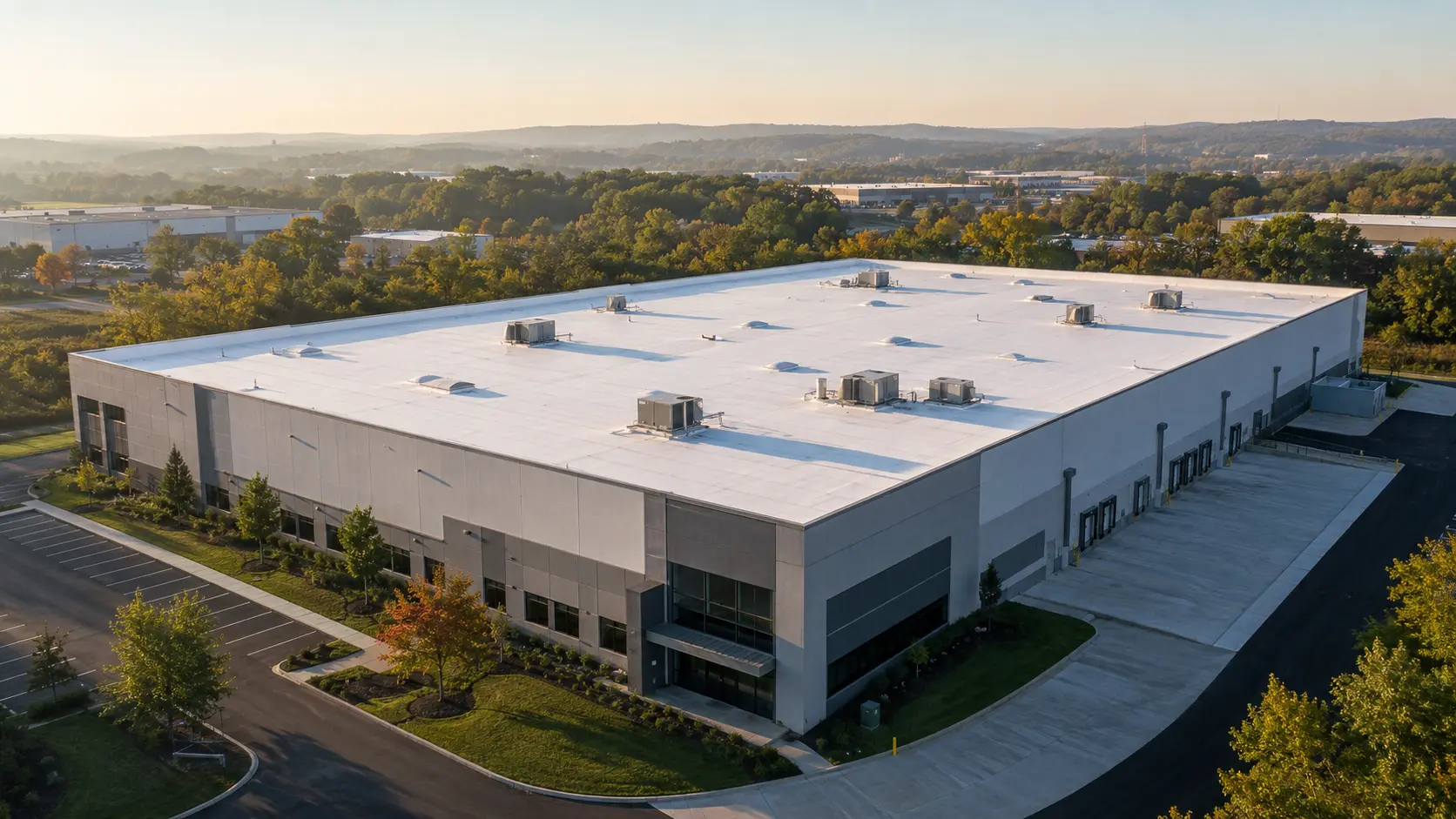
Commercial roofing expertise
Roofing guidance for facilities, tenants, inventory, equipment, and daily operations.
Commercial roof inspection, repair, replacement, coatings, restoration, emergency service, and preventative maintenance for warehouses, industrial buildings, manufacturing facilities, offices, retail centers, healthcare facilities, schools, churches, and municipal buildings across Akron and Summit County.
Roofing guidance for facilities, tenants, inventory, equipment, and daily operations.
Repair, roof restoration, and replacement decisions begin with documented roof conditions.
Snow, ice, freeze-thaw cycles, wind, hail, and drainage are built into the recommendation.
Clear repair, maintenance, and capital priorities help owners budget with confidence.
A commercial roof is part of a working facility. Repair, replacement, coating, and maintenance decisions affect interior operations, equipment, inventory, tenants, energy use, capital budgets, safety, warranties, and future roof performance.
A condition-based commercial roof assessment identifies the failure mechanism, the extent of wet insulation or damaged materials, and whether targeted repair, roof restoration, replacement, or preventative maintenance is the responsible next step.
Address active water entry, unsafe conditions, vulnerable equipment, and exposed materials.
Evaluate membrane, insulation, deck, drainage, details, moisture extent, age, and prior work.
Compare targeted repair, restoration, recovery, replacement, and maintenance using lifecycle value.
Commercial roof repair, replacement, inspection, maintenance, coatings, restoration, and emergency roofing solve different problems. The right scope starts with the roof system, current condition, building use, and operational priorities.
Find the source, define the affected assembly, and complete repairs that address the failure—not merely the interior symptom.
Explore roof repair →02Capital planningBuild a replacement scope around roof condition, insulation, drainage, operations, code requirements, warranty goals, and long-term ownership cost.
Explore roof replacement →03Restoration optionRestore a suitable roof with repairs and a compatible fluid-applied system when the existing assembly is dry enough and structurally serviceable.
Explore roof coatings →04Lifecycle managementUse scheduled inspection, prioritized repairs, documentation, and budget planning to reduce preventable failures and extend roof serviceability.
Explore roof maintenance →05Condition intelligenceTurn roof condition into a documented decision: what needs attention now, what can be monitored, and what should be planned for later.
Explore roof inspections →06Urgent stabilizationPrioritize life safety, limit active water entry, protect operations, document conditions, and build a permanent repair plan once the roof can be evaluated safely.
Explore emergency roofing →The right choice depends on membrane condition, moisture extent, insulation and deck performance, repair history, remaining service life, and the owner’s long-term plan for the property.
TPO, EPDM, PVC, modified bitumen, built-up roofing, metal roofing, and roof coatings perform as complete assemblies. Insulation, vapor control, attachment, drainage, perimeter design, flashings, penetrations, installation quality, and maintenance all influence service life.
A heat-welded single-ply membrane commonly selected for large low-slope commercial roofs.
System guide →EPDMA flexible synthetic rubber membrane with a long track record on low-slope commercial buildings.
System guide →PVCA heat-welded single-ply membrane often considered where grease, oils, chemicals or demanding rooftop exposures are part of the design.
System guide →Modified BitumenA reinforced asphalt-based membrane installed in plies using adhered, self-adhered, hot-applied or torch-applied methods as appropriate.
System guide →Built-Up RoofingA multi-ply asphalt roof assembly valued for redundancy and robust surfacing on suitable buildings.
System guide →Metal RoofingStructural and architectural metal systems that can provide long service, distinct drainage behavior and durable weather protection.
System guide →| System | Seam / assembly approach | Common planning emphasis |
|---|---|---|
| TPO / PVC | Heat-welded single-ply | Seam quality, details, reflectivity, exposure compatibility |
| EPDM | Flexible rubber single-ply | Prepared seams, traffic protection, perimeter and flashing condition |
| Modified / BUR | Reinforced or multi-ply asphalt systems | Redundancy, surfacing, application logistics, weight and substrate |
| Metal | Structural or architectural panels | Movement, fasteners, seams, corrosion, condensation and snow behavior |
Warehouses, industrial buildings, manufacturing facilities, office buildings, retail centers, healthcare facilities, schools, churches, and municipal buildings can use the same roof system while requiring different safety, access, phasing, and communication plans.
Roof planning must protect production, process equipment, utilities, and occupied work areas while accounting for penetrations, exhaust, vibration, and demanding operating schedules.
Large roof areas, valuable inventory, dock activity, drainage capacity, and uninterrupted logistics make early leak control and disciplined maintenance especially important.
Tenant comfort, interior finishes, rooftop equipment, noise, access, and phased scheduling shape the right repair or replacement plan.
Occupied storefronts need clear coordination, protected entrances, clean work zones, and roofing schedules designed around customer traffic.
Sensitive operations, ventilation, safety, documentation, and continuity requirements demand careful preconstruction planning.
Budget stewardship, varied roof elevations, public access, resident communication, and long-range capital planning all influence the scope.
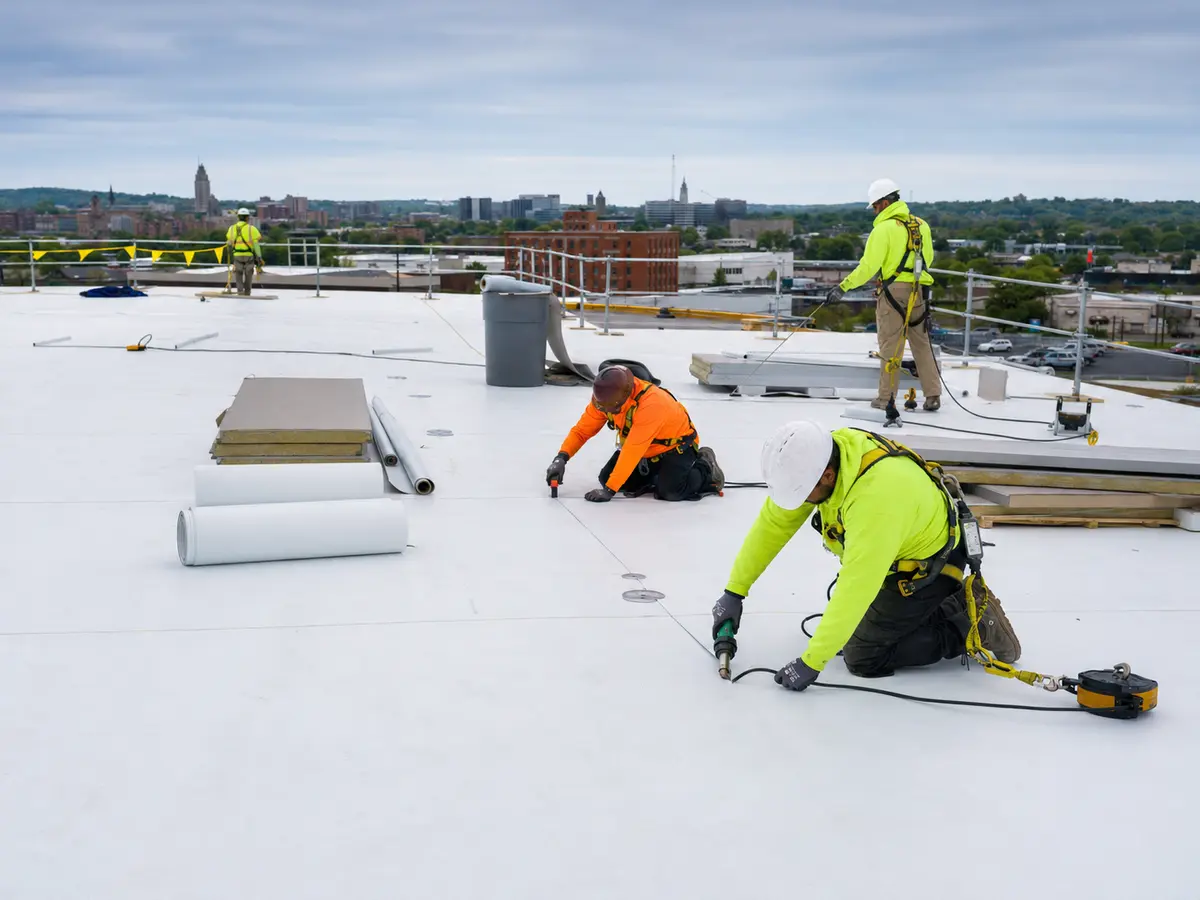
Commercial roof repair and replacement planning should account for loading areas, sensitive equipment, air intakes, noise and odor concerns, occupant routes, rooftop trades, daily dry-in, emergency contacts, and weather contingencies before work begins.
Commercial roof leaks, ponding water, open seams, failed flashings, wet insulation, storm damage, and aging membranes require assembly-level diagnosis before a durable repair is specified.
A leak’s interior location rarely identifies its rooftop source. Membrane seams, flashings, curbs, drains, walls, and penetrations all require systematic evaluation.
Standing water can accelerate membrane aging, stress seams, collect debris, and reveal problems with drains, scuppers, slope, or deck deflection.
Transitions and penetrations move differently from the field of the roof. Small openings can admit moisture into insulation long before interior damage appears.
Trapped moisture can reduce thermal performance, expand the repair area, corrode metal components, and complicate a future restoration or replacement.
Wind uplift, displaced edge metal, punctures, impact marks, and wind-driven rain should be documented promptly—even when the roof is not visibly leaking.
Surface wear, brittleness, shrinkage, cracking, and repeated patching indicate that the roof should be evaluated as a system rather than as isolated defects.
Water can move laterally through insulation and metal deck profiles, reducing thermal performance, contributing to corrosion, and expanding the eventual commercial roof repair area before a larger interior symptom appears.
View Commercial Roof Problems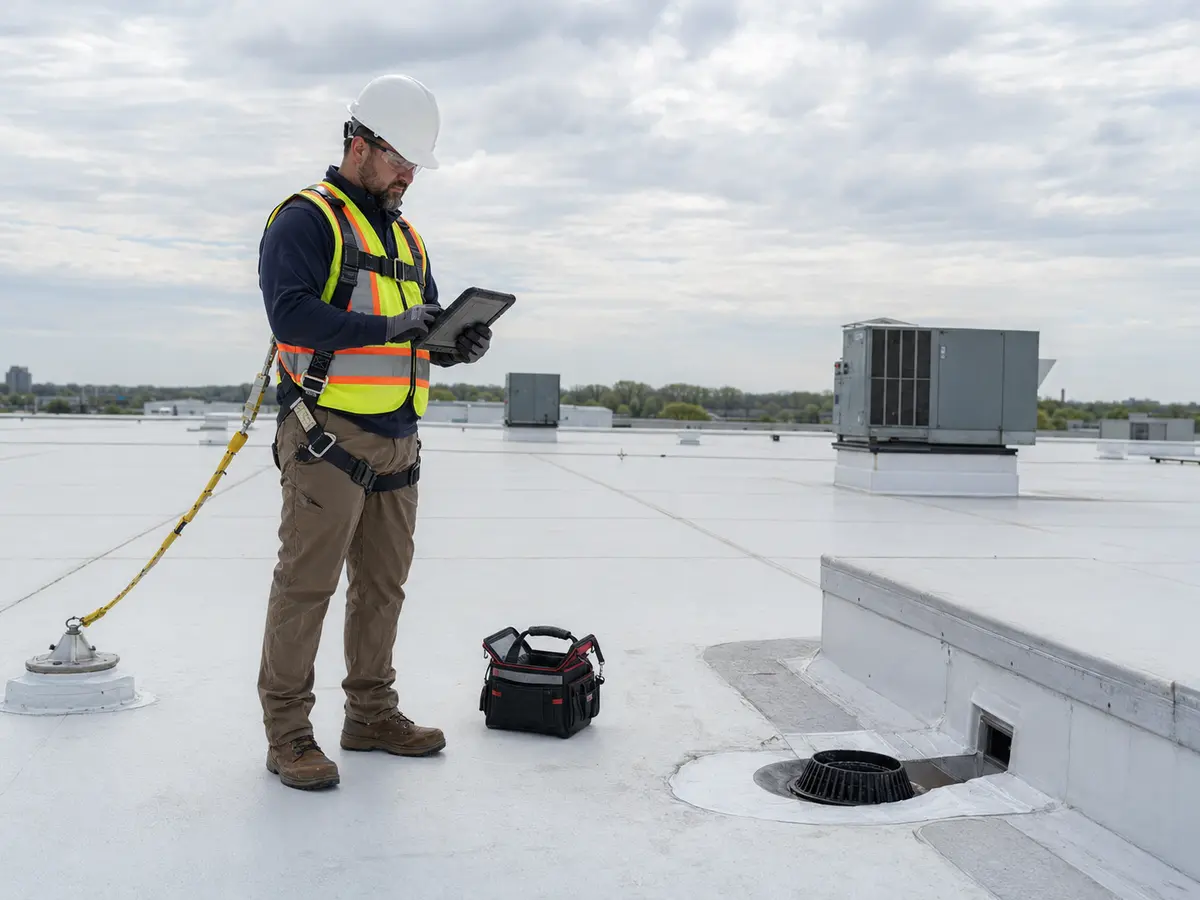
A commercial roof inspection documents the membrane, flashings, penetrations, drainage, perimeter, repair history, and visible moisture indicators. Findings should distinguish emergency repairs from planned maintenance, roof coating opportunities, and replacement or capital needs.
Membrane, seams, flashings, penetrations, edges, traffic areas and visible damage.
Drains, scuppers, gutters, slope, ponding patterns, debris and overflow paths.
Photos, findings, risk levels, repair priorities and practical next steps.
Preventative maintenance combines spring and fall commercial roof inspections, drainage cleaning, prioritized repairs, documentation, and follow-up after major wind, hail, snow, or ice events across Akron and Northeast Ohio.
Review freeze-thaw movement, snow and ice effects, open details, drainage debris and new interior reports.
Use favorable weather windows for repairs, coating preparation, replacement phases and drainage corrections.
Clear drainage, secure vulnerable details, review sealants and close out repair priorities before winter.
Check edges, flashings, penetrations, impact areas, displaced materials and new water-entry evidence.
From the first building conversation through inspection, scope, coordinated roofing work, and closeout, the process gives owners, facility teams, and property managers documented decisions and clear next steps.
Clarify the roof concern, property use, known history, timing, stakeholders and operational constraints.
Evaluate the membrane, flashings, penetrations, drainage, perimeter, visible moisture indicators and repair history.
Separate urgent water-entry risks from planned repairs, restoration opportunities and long-range capital needs.
Compare appropriate systems, preparation, insulation, details, phasing, maintenance and total ownership implications.
Plan access, safety, weather, staging, daily dry-in and communication around the building’s real operations.
Document completed work, final conditions, maintenance priorities and the next recommended inspection milestone.
Commercial roof inspection, repair, replacement, restoration, and maintenance services are centered in Akron and Summit County, with selected projects throughout Medina, Stark, Portage, Wayne, and Cuyahoga counties in Northeast Ohio.
View Commercial Roofing Service AreaGet practical answers about commercial roof repair, replacement, inspections, coatings, maintenance, roofing systems, cost drivers, leak diagnosis, and project planning for Akron-area properties.
Read Commercial Roofing FAQs →The decision depends on the extent of moisture, remaining membrane condition, deck integrity, drainage, repair history, age, operational risk and ownership goals. Localized dry defects often support repair; a serviceable roof with manageable moisture may qualify for restoration; widespread failure or saturation usually shifts the analysis toward replacement.
There is no single lifespan for every commercial roof. System type, thickness, insulation, attachment, workmanship, drainage, rooftop traffic, exposure, maintenance and the timing of repairs all matter. A condition-based plan is more reliable than using age alone.
A credible cost requires an inspection and defined scope. Roof area, access, tear-off, wet insulation, deck repairs, penetrations, edge details, drainage, chosen system, attachment, warranty goals and operational phasing can materially change pricing.
Spring and fall inspections are a practical baseline. Additional checks are appropriate after significant hail, wind, heavy snow or ice, after rooftop mechanical work, and whenever new leaks, drainage changes or displaced materials appear.
Many projects can proceed while a building remains operational. The plan should address access, staging, noise, odors, air intakes, tenant communication, protected walkways, daily dry-in and work around sensitive operations.
Look for a clear roof-area definition, existing-condition findings, preparation and tear-off assumptions, materials, insulation, attachment, details, drainage work, exclusions, phasing, safety coordination, quality checks, closeout documents and warranty terms when applicable.
Share the building type, active leaks or storm damage, known roof system and age, repair history, project timing, and operational constraints. That context helps define an efficient commercial roof inspection and the right next step.
Tell us what is happening and where the property is located.
Share the roof system or age if known—uncertainty is completely fine.
Identify urgent risks, timing, and the decision your team needs to make.